


Three amazing women share their personal stories about their reasons for becoming surrogates.

There has been a lot of talk lately about surrogacy, with new TV shows and movies featuring surrogates. Much of what the media portrays is misleading. So why do women decide to become surrogate mothers?
If you asked the average person on the street, their response would probably be "for the money" but nothing could be further from the truth. While money does play a factor in most surrogacies, a woman cannot decide to become a surrogate simply for the money.
First, the money, when compared to the time and discomfort involved, is insignificant. A gestational surrogacy arrangement can take, on average, 12-18 months, sometimes longer.
There are months of testing, examinations, interviews, and attorney arrangements. All this is after a woman has researched surrogacy for months, perhaps years.
Then, once all of that is done, a gestational carrier needs to go through weeks, perhaps months of medications, including daily injections, to prepare her body for an embryo transfer. Not all embryo transfers result in pregnancy, however, it can take several weeks to determine if it failed.
If the transfer is unsuccessful, the gestational surrogate will undergo the complete procedure again, with generally one to three months wait in between. Sometimes a surrogacy will involve three to four failed transfers.
Once a transfer is successful, a surrogate mother will carry a baby or babies for the intended parents for the full gestational period of 40 weeks. After delivery, she may even pump breastmilk for an extended period of time.
And, no matter how long the entire process takes, a surrogate mother does this all for $15,000-20,000. When you think of the fact that this process can take upwards of a year and a half, this is not a significant amount of money.
So if not for the money, why do women become surrogate mothers? The reasons are varied.
Some women become surrogates for close family and friends. Others have had infertility touch their lives on a personal level, and want to give back to those who are in need.
Some love being pregnant, and want to experience pregnancy again without having another child enter their family. While yet others simply want to give back to the world in a large way.
Not every woman could become a surrogate mother. Most women would be unable to differentiate the feelings she has towards her own children that she carried and the child she is carrying for someone else.
But surrogate mothers are unique in the fact that they are able to make that distinction, and in doing so are able to help grow another family, from a purely unselfish and giving heart. These women view surrogacy as a sort of extended baby-sitting project, and when its all over, they are happy to reunite parent with child.
Regardless of the reasons why a woman becomes a surrogate, most gestational carriers choose to do this because they are wonderful, intelligent women with very large hearts, full of compassion. They are in no ways money-hungry, and in fact often reduce or eliminate their fees in order to help the right set of intended parents.
If you asked the average person on the street, their response would probably be "for the money" but nothing could be further from the truth. While money does play a factor in most surrogacies, a woman cannot decide to become a surrogate simply for the money.
First, the money, when compared to the time and discomfort involved, is insignificant. A gestational surrogacy arrangement can take, on average, 12-18 months, sometimes longer.
There are months of testing, examinations, interviews, and attorney arrangements. All this is after a woman has researched surrogacy for months, perhaps years.
Then, once all of that is done, a gestational carrier needs to go through weeks, perhaps months of medications, including daily injections, to prepare her body for an embryo transfer. Not all embryo transfers result in pregnancy, however, it can take several weeks to determine if it failed.
If the transfer is unsuccessful, the gestational surrogate will undergo the complete procedure again, with generally one to three months wait in between. Sometimes a surrogacy will involve three to four failed transfers.
Once a transfer is successful, a surrogate mother will carry a baby or babies for the intended parents for the full gestational period of 40 weeks. After delivery, she may even pump breastmilk for an extended period of time.
And, no matter how long the entire process takes, a surrogate mother does this all for $15,000-20,000. When you think of the fact that this process can take upwards of a year and a half, this is not a significant amount of money.
So if not for the money, why do women become surrogate mothers? The reasons are varied.
Some women become surrogates for close family and friends. Others have had infertility touch their lives on a personal level, and want to give back to those who are in need.
Some love being pregnant, and want to experience pregnancy again without having another child enter their family. While yet others simply want to give back to the world in a large way.
Not every woman could become a surrogate mother. Most women would be unable to differentiate the feelings she has towards her own children that she carried and the child she is carrying for someone else.
But surrogate mothers are unique in the fact that they are able to make that distinction, and in doing so are able to help grow another family, from a purely unselfish and giving heart. These women view surrogacy as a sort of extended baby-sitting project, and when its all over, they are happy to reunite parent with child.
Regardless of the reasons why a woman becomes a surrogate, most gestational carriers choose to do this because they are wonderful, intelligent women with very large hearts, full of compassion. They are in no ways money-hungry, and in fact often reduce or eliminate their fees in order to help the right set of intended parents.
Rayven Perkins is an author and two-time surrogate mother. To find out how to become a gestational surrogate mother, or more information on gestational surrogacy, please see her site What is a Gestational Surrogate Mother?
Article Source: http://EzineArticles.com/?expert=Rayven_Perkinshttp://www.npr.org/2012/04/17/150589059/carrying-dreams-why-women-become-surrogates

EnlargeCourtesy of Macy WidofskySince NPR's Marisa Penaloza spoke with Macy Widofsky, she has been deemed a good candidate for surrogacy and matched with a couple.
Courtesy of Macy Widofsky
Since NPR's Marisa Penaloza spoke with Macy Widofsky, she has been deemed a good candidate for surrogacy and matched with a couple.
April 17, 2012
Last in a four-part reportSurrogacy is an idea as old as the biblical story of Sarah and Abraham in the book of Genesis. Sarah was infertile, so Abraham fathered children with the couple's maid. Today, there are many more options for people who want to grow their families — and for the would-be surrogates who want to help.
Macy Widofsky, 40, is eager to be a surrogate.
"I have very easy pregnancies. All three times have been flawlessly healthy, and I wanted to repeat the process," she says, "and my husband and I won't be having more children of our own."
Widofsky sits in the lobby of a fertility clinic in Reston, Va., where she's being tested to find out if she's a good candidate. Surrogacy runs in her family: Her mother was a surrogate when Widofsky was 12, and the experience left a mark.
"I was very impressed then that she was willing to help a family out this way, and I didn't realize at the time how uncommon that was," she says.
Widofsky's mom did what's called "compassionate" surrogacy, meaning she wasn't paid. Some women do it for family or a friend. Today, though, most surrogates get between $20,000 and $25,000 to bear a child for someone else.
Why One Surrogate Wanted To Help
Whitney and Ray Watts are the parents of 3-year-old J.P. Whitney carried twins for Susan and Bob de Gruchy.
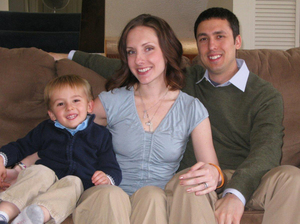
EnlargeCourtesy of Whitney Watts Surrogate Whitney Watts with her son, J.P., and husband, Ray. She says she was motivated to help others have a family because her own parents had infertility problems.
Courtesy of Whitney Watts
Surrogate Whitney Watts with her son, J.P., and husband, Ray. She says she was motivated to help others have a family because her own parents had infertility problems.
That's part of what could make some people scratch their head. After all, it's easier to believe that a woman would give up a child from her womb for money rather than a desire to help.
Whitney, 25, says her parents went through infertility nightmares, and that gave her determination to help someone make a family. She says she didn't think about bonding with the baby.
"It was [in vitro fertilization]. It was their embryos," she says. "You just know they are not yours. You're just keeping them for a time to let them grow and then give them back to their parents, because they were never my babies. It's just my uterus that's keeping them."
Not Doing It For The Money
Sitting next to each other, 27-year-old Ray looks adoringly at his wife; they finish each other's sentences when they speak. The Wattses say they were looking for a couple they could connect with.
"It was very important to us to have a relationship with them," Whitney says. "Yes, it's a business contract in a sense, but it's so much more than that." Her husband agrees.
"Had Susan and Bob just wanted to pay money and get a kid, that would have been a deal breaker right away," he says.
The Watts say the health of the pregnancy — and ultimately of the twins — relied on the relationship developed by the couples.
She says explaining surrogacy to her children wasn't hard.
"Ms. Becky wanted to bake a pie," she told them, "and she had all the ingredients. She got her pie together, went to put it in the oven, and her oven was broken."
Are You Doing Good If You're Getting Paid?
The issue of money, though, is real. It makes some people feel uneasy because motherhood is not typically financially compensated. Whitney Watts says she looked into compassionate surrogacy — doing it for free — but it didn't feel right.
"I would do compassionate [surrogacy] for a friend, but not for someone I don't know, through an agency," she says. "It wouldn't feel appropriate ... because you don't know what you are going to do until you get there."
Whitney says she didn't want to put her family through financial stress. As it turned out, she spent 55 days on bed rest at the hospital.
Elaine Gordon, a clinical psychologist in Los Angeles, counsels couples on family-building, including surrogacy, and on the issue of payment.
"I think people automatically feel that if money is involved then there is no altruism involved, and that's not necessarily true," she says. "We are all compensated for the work we do, and we still want to do good work even though we are compensated."
Gordon says many surrogates tell her the experience of having a child for someone else is so powerful that they want to do it again.

No comments:
Post a Comment